
Logo
  • Home
  • About Us
    • Vision and Values
    • Playing Learning
    • Privacy Policy
    • Sitemap
    • Ofsted Report
  • Parents
    • Admissions
    • Communication
    • Why Wimbledon Day
    • Fees and Funding
    • FAQS
  • Nursery
    • Activities
    • Facilities
    • Health and Well Being
    • Local Offer
    • Meals
    • Opening Times
  • Rooms
    • Baby rooms
    • Pre School
    • Toddler One
    • Toddler Two
  • Our Team
    • Careers
    • Careers Application Form
    • Our Staff Philosophy
    • Recruitment
    • Testimonials
  • Contact Us
  • Blog
Alt
Wimbledonday Nursery

>

Activities for Kids

>

What Is EYFS and How Does a Wimbledon Nursery Support Your Child’s Learning?

What Is EYFS and How Does a Wimbledon Nursery Support Your Child’s Learning?

What Is EYFS? A Parent's Guide | Wimbledon Day Nursery
  • by Admin
  • 26/06/2026

What Is EYFS and How Does a Wimbledon Nursery Support Your Child’s Learning?

Key Takeaways
  • EYFS stands for the Early Years Foundation Stage — the statutory framework every nursery in England must follow for children from birth to age five.
  • It covers seven areas of learning, split into three prime areas and four specific areas, all delivered through play.
  • A good nursery brings the EYFS to life through everyday activities, observation, and a key person who tracks each child’s progress.


EYFS stands for the Early Years Foundation Stage — the statutory framework that sets the standards for learning, development, and care for every child in England from birth to age five.

If you have ever read a nursery prospectus and felt lost in acronyms, you are not alone. The EYFS sounds technical, but the idea behind it is simple: it makes sure every nursery, preschool, and childminder gives children a consistent, high-quality start. This guide explains what it means and how a good Wimbledon nursery brings it to life.

What does EYFS mean for your child?

The EYFS means your child learns through play across seven connected areas of development, supported by a key person who observes and guides their progress.

It is a legal framework, which means every Ofsted-registered setting must follow it. For you as a parent, that is reassuring — it guarantees a baseline of quality and safety wherever your child attends. The framework sets out what children should be learning, how staff should support them, and the welfare standards every setting must meet.

Crucially, the EYFS is built around play. Children do not sit at desks. They learn by exploring, building, talking, and pretending — because that is how young children learn best.

What are the seven areas of learning?

The EYFS has seven areas of learning: three prime areas that build foundation skills, and four specific areas that grow from them.

The three prime areas come first because everything else builds on them. The four specific areas develop as a child’s foundation strengthens. Here is how they fit together.
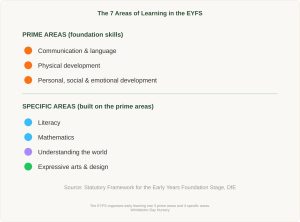
The 7 Areas of Learning in the EYFS


The prime areas — communication, physical development, and personal, social and emotional development — are the bedrock. Without these, the specific areas like literacy and mathematics cannot flourish. That is why a strong nursery focuses heavily on the prime areas in the early years, especially for babies and toddlers.

How does a Wimbledon nursery bring the EYFS to life?

A quality nursery delivers the EYFS through purposeful play, careful observation, and a key person system that tailors learning to each child.

At Wimbledon Day Nursery, the EYFS is not a document on a shelf — it shapes every part of the day. A water-play tray teaches early science and language. A group story builds attention and vocabulary. Tidy-up time develops independence and responsibility.

Each child has a key person who observes their progress, notes their interests, and plans activities around them. This approach is rooted in our wider educational philosophy. You can read more about what pedagogy in the early years means and how it guides our practice every day.

How will you know your child is making progress?

Under the EYFS, your child’s key person tracks progress through ongoing observation and shares it with you through regular updates and a progress check at age two.

You will not receive exam results. Instead, you will get a genuine picture of your child as a learner — what they enjoy, what they are mastering, and where they need encouragement. The statutory progress check between ages two and three flags any areas needing extra support early.

The best way to understand how the EYFS shapes daily learning is to see it in person. Explore our nursery and rooms to see how each space is designed around these seven areas of learning.

See How We Bring the EYFS to Life

The best way to understand the EYFS is to watch it in action. Book a visit to Wimbledon Day Nursery and see how play-based learning works across every age group.

Book a visit


Frequently Asked Questions

What does EYFS stand for?
EYFS stands for the Early Years Foundation Stage. It is the statutory framework in England that sets the standards for the learning, development, and care of children from birth to five years old. Every Ofsted-registered nursery, preschool, and childminder must follow it.

What are the prime and specific areas of the EYFS?
The three prime areas are communication and language, physical development, and personal, social and emotional development. The four specific areas are literacy, mathematics, understanding the world, and expressive arts and design. The specific areas build on the prime areas.

Is the EYFS just about academic learning?
No. The EYFS is built around play and prioritises social, emotional, and physical development alongside early literacy and numeracy. Children learn by exploring, talking, and pretending rather than formal lessons, because this is how young children learn most effectively.

What is the EYFS progress check at age two?
The progress check at age two is a short written summary of your child’s development in the three prime areas. Your child’s key person completes it between the ages of two and three to identify strengths and flag any areas where extra support might help.

What is a key person under the EYFS?
A key person is the named staff member responsible for your child’s learning and wellbeing. They observe progress, plan activities around your child’s interests, build a secure relationship, and act as your main point of contact — a requirement under the EYFS framework.
  • Tags:
  • early years foundation stage
  • eyfs areas of learning
  • eyfs explained for parents
  • eyfs nursery wimbledon
  • what is eyfs

Post navigation

Prev Article

Recent Posts

  • What Is EYFS and How Does a Wimbledon Nursery Support Your Child’s Learning?
  • School Readiness in Wimbledon: How Nursery Helps Prepare Your Child for School
  • Nursery Settling-In Period: What Parents Can Expect in the First Few Weeks
  • Understanding Nursery Fees in Wimbledon – What Families Actually Pay in 2026
  • Nurseries in Wimbledon — An Honest Guide for Parents Choosing Childcare in SW19

Categories

  • Activities for Kids
  • Child Nurseries
  • Child Takecare
  • Education
  • Entertaining
  • Nursery
  • Pre School

Archives 

  • June 2026
  • May 2026
  • April 2026
  • March 2026
  • February 2026
  • January 2026
  • December 2025
  • November 2025
  • October 2025
  • September 2025
  • August 2025
  • July 2025
  • June 2025
  • May 2025
  • April 2025
  • March 2025
  • February 2025
  • January 2025
  • December 2024
  • November 2024
  • October 2024
  • September 2024
  • August 2024
  • July 2024
  • June 2024
  • May 2024
  • April 2024
  • March 2024
  • February 2024
  • January 2024
  • December 2023
  • November 2023
  • October 2023
  • September 2023
  • August 2023
  • July 2023
  • June 2023
  • May 2023
  • April 2023
  • March 2023
  • February 2023
  • November 2021
  • August 2020
  • June 2020
  • April 2020
  • March 2020
  • January 2020
  • December 2019
  • November 2019
  • October 2019
  • August 2019
  • July 2019
  • June 2019
  • April 2019

About Us

Vision and Values
Playing Learning
Privacy Policy
Sitemap

About Us

  • Vision and Values
  • Playing Learning
  • Privacy Policy
  • Sitemap

Contact

  • +44(0)20 8542 4175
  • +44(0)87 1528 4549
  • info@wimbledondaynursery.co.uk
  • 32 Montague Road Wimbledon, London Sw19 1Ta

Contact

  • +44(0)20 8542 4175
  • +44(0)87 1528 4549
  • info@wimbledondaynursery.co.uk
  • 32 Montague Road Wimbledon, London Sw19 1Ta

Rooms

  • Baby Room
  • Toddler One
  • Toddler Two
  • Pre School

Nursery

Opening Times
Meals
Activities
Facilities
Health & Well being
Local Offer

Rooms

  • Baby Room
  • Toddler One
  • Toddler Two
  • Pre School

Nursery

  • Opening Times
  • Meals
  • Activities
  • Facilities
  • Health & Well being
  • Local Offer

Newsletter

    Newsletter

      Copyright © 2026 Wimbledon Day Nursery. Created By Haarty Hanks